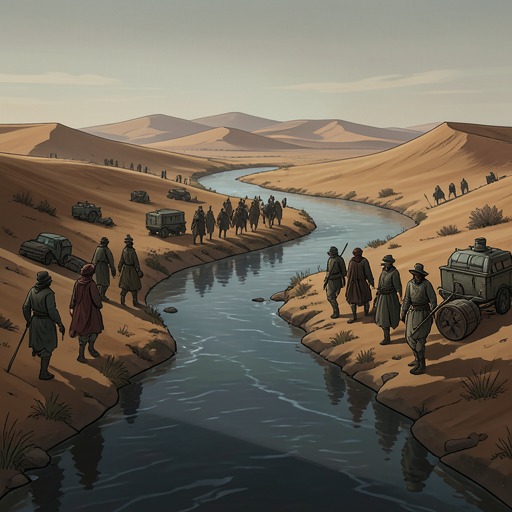
Isar River
A Princess of MarsThe River Iss is both a geographic feature and a central threshold in Martian beliefs about death. At about one thousand years of age, Martians are said to embark voluntarily upon a final journey down its waters; none returns, and the journey leads toward a place the living cannot know. The river’s role contrasts with the violent deaths that dominate ordinary life on Mars, making it an imagined passage out of a world defined by conflict.
The final pilgrimage
Martians show little visible change between maturity, reached at about forty, and extreme old age. At roughly one thousand years, however, they undertake the pilgrimage down the River Iss. The journey is irreversible: no living Martian knows where it leads, and the account states that a traveler would not be allowed to live if he returned. The river therefore marks not simply the end of a long life but a boundary beyond which ordinary knowledge and social life do not extend.
The pilgrimage is uncommon compared with the many violent ends described in the account. About one Martian in a thousand dies of sickness, and perhaps twenty take the voluntary journey; the great majority die through duels, hunting, aviation, and war, while many children fall victim to the great white apes of Mars. An adult Martian’s average life expectancy is about three hundred years, though it might approach a thousand without the causes of violent death. Against this arithmetic, the Iss stands for a rare, chosen ending amid a society where death is usually imposed by danger or conflict.
A feared route into the unknown
The river’s lower destination is described through an absence of knowledge. According to Dejah Thoris, the River Iss empties into the lost sea of Korus in the valley Dor, where legends say a different language is spoken. She explains that no record exists of a Barsoomian returning upstream from the shores of Korus. When John Carter insists that he is not from Dor and has never seen the Iss, her urgent questioning makes clear how alarming a supposed return would be: she believes anyone who had come back from that region would be killed on the surface of Mars.
The river consequently functions as a limit on what Martians can verify. Its destination belongs to inherited legend rather than direct report, and the prohibition against returning makes the gap permanent. For the old, the journey is presented as a voluntary departure; for those who remain, its meaning is inseparable from uncertainty about what lies beyond.
Sola’s view of life and death
The River Iss also enters Sola’s critique of Green Martian society. Defending her sympathy for Dejah Thoris, she describes her people as continually at war—with other communities, with the Red Martians, and among themselves. She casts the span from hatching to the final journey down the dark, mysterious river as an unbroken period of bloodshed, and says that an early death may be fortunate compared with continuing such an existence.
Her words turn the customary pilgrimage into a measure of social despair. The river promises no known afterlife and offers no evidence of return, yet its departure from ordinary life can still be imagined as preferable to a world in which violence begins in childhood and persists through adulthood. This reading is Sola’s condemnation of the society around her, not proof of what awaits travelers beyond the river.
Narrative significance
The Iss links two otherwise distinct forms of uncertainty: the physical decline of Mars and the unknown fate of its dead. The planet’s waning resources and its people’s long lives are presented alongside customs and conflicts that make life precarious; the river’s distant, unverified destination gives that precarious existence a final horizon. Its importance comes less from an observed journey than from the beliefs and judgments organized around it: old age culminates in departure, legend forbids return, and Sola invokes the river when weighing a violent life against an unknowable end.